this is designed for the about link on the homepage to auto expand
Definition of Energy and Energy Conservation
Introduction
Here's a question for the ages: what is energy? We use the term all the time in our daily lives, yet if I asked you to give a concrete definition of what energy was I doubt you would be able to do it. It's obviously something that exists, but is hard to define concisely and isn't tangible. Therefore, I'll leave you to seek your own idea of energy.
In physics, energy is a scalar quantity that has the unit of joules. (This is the same as work for a reason, as we'll see later!) This does not indicate that energy is never negative, though we rarely think of it that way. Yes, for the vasy majority of cases energy will be positive, but there are some important cases where energy is more easily thought of as a negative quantity.
Kinetic Energy
There are many different types of energy. The first important type is kinetic energy, which is the energy that moving objects have. It is defined quite simply as:
$$K = \dfrac12 mv^2$$ Now, recall that the velocity of any object is frame-dependent. This means that for different observers in different reference frames, the kinetic energy of an object will vary. In other words, the kinetic energy is a frame-dependent quantity. This kind of leads into the idea that energy is relative, but the nuances of this result aren't important at our level.
The formula makes a lot of sense. An object that moves faster evidently has more energy, and more massive objects also intutively have more energy than smaller ones. It is important to note that this energy scales with the square of the speed of an object, which explains why vehicle collisions become much more deadly as speeds get higher.
Work-Energy Theorem
With this, we can present the work-energy theorem:
The work done on an object is equivalent to its change in kinetic energy. $$W = \Delta K$$ With that, let's see how this new theorem compares to using our previously-used force-analysis methods.
A box of mass $m = 4.0~\textrm{kg}$is pushed from rest horizontally with a force $F = 50 ~\textrm{N}$ on a horizontal, frictionless surface over a distance of 10 meters. What is its velocity at the end of the ten meters? Use both the method of forces and the work-energy theorem.
For our method of force analysis, we can recognize that forces are balanced vertically, while $F$ is the only force acting in the x-direction. This tells us that it must cause some acceleration.
$$F = ma$$ $$a = \dfrac{F}{m} = 12.5 ~\textrm{m/s}^2$$ This simplifies the problem down into a kinematics one, and we can one of our key kinematics formulas to derive the velocity at the end of 10 meters. Since the initial velocity is zero, we can drop one of the terms.
$$ v^2 = 2ax$$ $$v = \bbox[3px, border: 0.5px solid white]{15.8 ~\textrm{m/s}}$$ Now, we want to do the same problem using the newfound technique of the work-energy theorem. The work in this case is equal to the force times the displacement since they are parallel.
$$W = F \cdot x = 500 \textrm{J}$$ This is equal to $\Delta K$, so we can write:
$$ W = \dfrac12 mv^2$$ $$ v = \sqrt{\dfrac{2W}{m}} = \bbox[3px, border: 0.5px solid white]{15.8 ~\textrm{m/s}}$$ Both methods yield the same answer, as they should. What nice and well-behaved formulas.
Currently, this is actually a flawed and incomplete view of work and energy. Like I said, there are a multitude of different types of energy, most of which are important to a complete understanding of the topic. We need to introduce more types of energy to widen the picture.
Potential Energy
The next type of energy that is important is potential energy. Like the name suggests, it is energy that has the potential to turn into another type of energy, usually kinetic. It arises due to the configuration of the system. I know that wording sounds vague and weird, but it'll make sense soon. Generally, it is referred to as $U$.
It is also crucial to note that the idea of potential energy is tied to the idea of a conservative force. In fact, only forces that are conservative can result in energy being stored in this form, as nonconservtive forces dissipate energy into a form like heat that is not completely recoverable. (Second Law of Thermodynamics!) Thus, you'll notice that all the potential energies we talk about are tied to some conservative force.
Gravitational Potential Energy
There are actually many subcategories of potential energy, each denoted with a subscript. The first is gravitational potential energy, which arises from positioning of an object relative to the Earth. Essentially, the higher up an object is, the more gravitational potential energy it will have. However, since there is not a clearly defined "zero potential energy" point (you might be tempted to think the ground has zero potential energy, but terrain exists!), we can actually define any point we want to have zero gravitational potential energy. We usually just pick the most convenient point.
Figure 1: Purple Guy has more gravitational potential energy than the red guy lying down. The exact formula for gravitational potential energy is:
$$U_g = mgh$$ Again, $h$ is measured vertically from a zero potential energy point of your choosing. Selecting this point is a good test of your problem-solving techniques. If you select the proper point, you can end up saving yourself a lot of work and simplify the problem significantly. Most of the time where to put this is obvious, but for problems that involve pulleys it is not immediately obvious. It is also possible for this energy to be negative, if your position is below that of the defined zero.
With that, let's test your conceptual understanding of the concept of gravitational potential energy.
For each of the scenarios described below, what is the change in potential energy of the object: positive, negative, or zero?
A box is raised via a rope elevator from the first floor to the seventh floor of a building.
Answer: The change in gravitational potential energy is positive, since the object's height from the Earth increases.
An athlete lifts a barbell once. (That means they lifted it up and put it back down.)
Answer: The change in gravitational potential energy is zero, since the barbell ends up at the same height it started at.
A rock is thrown off of a cliff into a lake.
Answer: The change in gravitational potential energy is negative, since the object goes from a higher point to a lower one.
Spring Potential Energy
Congratulations, you've understood gravitational potential energy! Now, I'll make a very cursory introduction of the other type of potential energy that's commonly seen, spring potential energy. As the name suggests, it is the potential energy stored in a spring, and is defined by:
$$U_s = \dfrac12 kx^2$$ With that, now we can talk about the second part of the title of this unit: the conservation of energy. This will let us solve many problems that force analysis cannot tackle. It's more common to deal with the change in gravitational potential energy $\Delta U_g$.
Spring Potential Energy
The other type of potential energy I should mention for this unit is the spring potential energy, the potential energy stored in a compressed or stretched Hookean spring. This is described by the equation:
$$U_s = \dfrac 12 kx^2$$ The more the spring is stretched or compressed, the more energy it stores. Note that the energy is positive regardless of whether you stretch or compress it because of that quadratic. This is a pretty simple and intuitive result.
I did say that we would mostly deal with Hookean springs which would follow the spring potential energy formula shown above, but there is actually a generalized formula that can relate force to potential energy. It involves a derivative:
$$ F = - \dfrac{dU}{dx} $$ This tells us that the force can be determined as the negative of the derivative of potential energy with respect to position. Try this for a Hookean spring, and you'll see that Hooke's law and our previous expression for the spring potential energy do indeed follow this formula.
What is the spring potential energy of a non-Hookean spring that follows the relation shown below? $$ F_s = - k_q x^2 $$ We need to apply the formula given above on this equation. We are given the force and asked for potential energy, so we must put the relation into the form of a differential equation:
$$ dU = - F dx $$ Doing some simple integration gives us:
It is now time for a few conceptual questions to test your understanding of potential energy. We will incorporate both the gravitational and spring potential energies into this little quiz.
For each of the scenarios described below, what is the change in potential energy of the object: positive, negative, or zero?
A box is raised via a rope elevator from the first floor to the seventh floor of a building.
Answer: The change in gravitational potential energy is positive, since the object's height from the Earth increases.
An athlete lifts a barbell once. (That means they lifted it up and put it back down.)
Answer: The change in gravitational potential energy is zero, since the barbell ends up at the same height it started at.
A rock is thrown off of a cliff into a lake.
Answer: The change in gravitational potential energy is negative, since the object goes from a higher point to a lower one.
A person sits on a spring-loaded mattress.
Answer: The change in spring potential energy is positive, since the springs in the mattress get compressed from equilibrium.
You pull hard on a spring until it snaps.
Answer: The change in spring potential energy is zero. A broken spring will snap back to its relaxed state, which stores no potential energy. Moreover, if you pulled hard enough on the spring to deform it, it would no longer be able to store any energy.
With that, we've completed our discussion of potential energy for the time being. Now, it's time to unite the two kinds of energy we've learned about and talk about the conservation of energy, which is, after all, the second part of this lesson's title. This technique will let us solve many problems that force analysis could not.
Energy Conservation
We are often asked to conserve energy. But, according to the law of conservation of energy, energy is always conserved.
The Law of Conservation of Energy: The total amount of energy in the universe is constant. Energy can change forms, but can never be created or destroyed.
How does one conserve energy then? Well, the statememnt is often used not to reference conserving all kinds of energy, but rather to prevent energy from being dissipated. Due to the Second Law of Thermodynamics, this isn't actually possible, but we can be more efficient with our energy consumption. Energy that is dissipated as heat, sound, or light cannot easily be recovered.
Under the specific conditions that there are no dissipative forces in the system and no net external force acts on the system, we can turn the generalized form of the conservation of energy into the conservation of mechanical energy.
The Law of Conservation of Mechanical Energy: If no nonconservative forces and no net external force act within a system, total mechanical energy will be conserved in all interactions.
Mechanical energy is simply the combination of potential and kinetic energy. Now, this can be a difficult result to apply due to how abstract the concept of energy is, but having a concrete handle on the concepts of potential and kinetic energy can help significantly. Perhaps a diagram would not be out of place here.
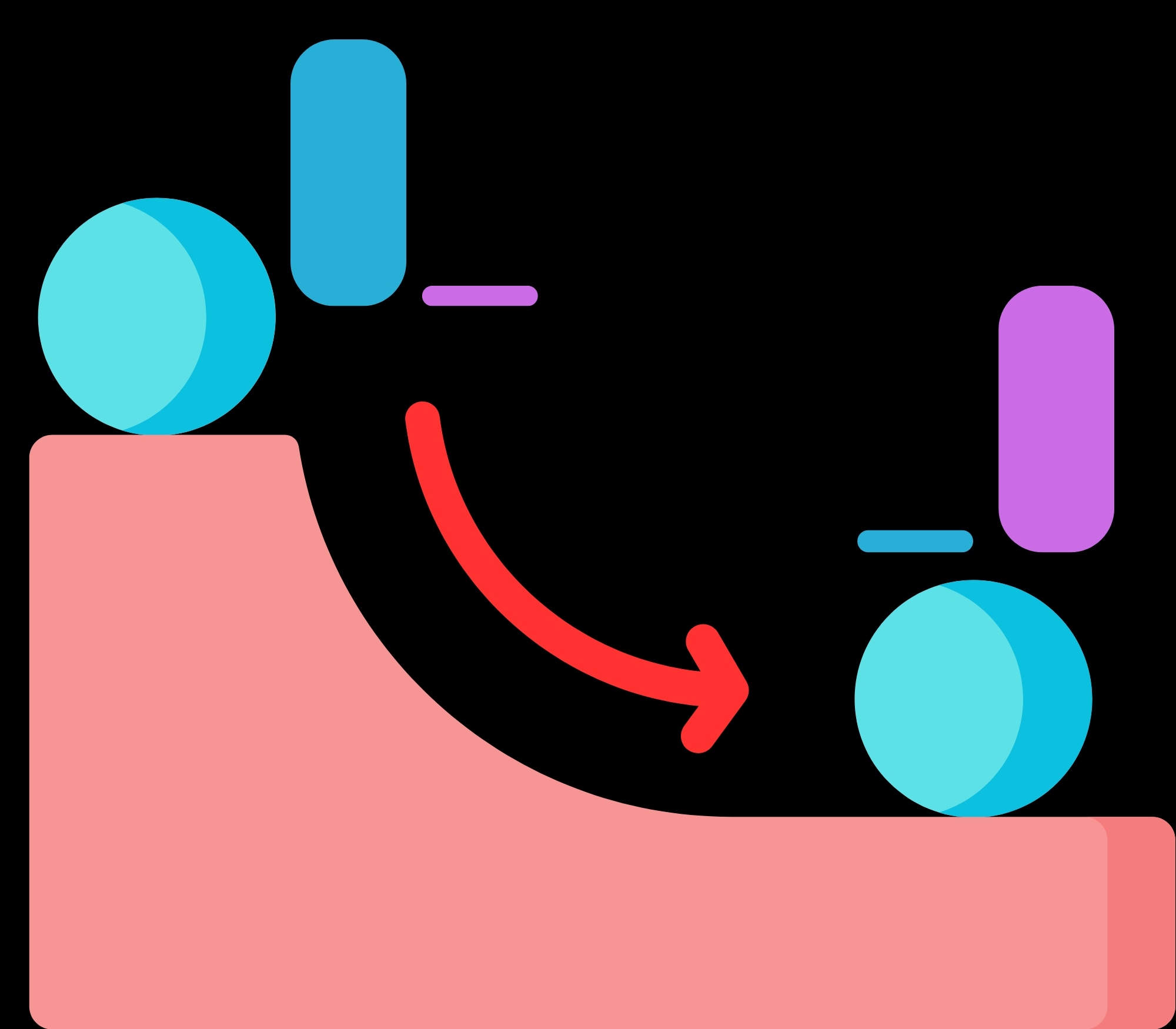
Figure 2: A diagram with bars to show conservation of mechanical energy. The deep blue bar represents the total amount of potential energy at each point where we analyze the system, while the purple bar represents the total kinetic energy of the system at those points. As you can see, the sum of the two stays constant. We can think of this as potential energy turning into kinetic energy as time progresses (but never being lost!).
For this particular scenario of a ball rolling down the ramp, we will assume the ball starts at rest at the top of the ramp. Initially, all of the energy in the system is potential because the ball has zero velocity. If we define the point of zero potential energy to be at the bottom of the ramp, then we end with zero potential energy. Thus, all of the initial potential energy is converted to kinetic energy through the process of the ball moving down the ramp. Here's a demo so you can get a feel for what I mean:
At each point throughout an object's motion, it has both potential and kinetic energy (either of which can be zero). However, the sum of the two energies at any given point is equal to the total mechanical energy, denoted $E_{mech}$ or just simply $E$. There is a popular method of visually displaying the amount of energy for an object, involving the use of different-length bars to denote the magnitude of energy at any point.
Figure 2: A diagram with bars to show conservation of mechanical energy. This diagram illustrates what I was talking about. The deep blue bars represent potential energy of the object at each position, while the purple bars represent kinetic energy. The sum of the two energies at any point is constant, which illustrates the idea of conservation of energy.
The specific scenario involves a ball rolling from rest down a ramp. You might be thinking to yourself how I determined the potential energy, since I said earlier it was relative. (If you weren't thinking this, pay close attention now!) Well, I defined the point of zero potential energy at the most convenient location: the bottom of the ramp. The ball will never go below the ramp, so it's a good spot and allows the potential energy term to go to zero when the ball reaches that position.
Now, a good way to think about what happens is to think of potential energy being converted to kinetic energy. As the ball rolls down the ramp, the gravitational force causes the ball to accelerate while also causing it to fall to a lower height; this is essentially trading potential energy into kinetic energy. Since we defined our zero at the bottom of the ramp, in this case all of the kinetic energy turns into potential energy. Here's a similar thing, but interactive:
Potential Energy Demo
You might have noticed that the ramp is not uniformly inclined; in other words, it's a curved ramp. This means that we can't use the result for an inclined plane we talked about earlier! However, the energy approach has no such weaknesses; we only care about the start and end positions' heights. This is a consequence of the conservative forces we talked about earlier! Do you notice anything special about the ramp? That's right. In all of our previous examples, we've dealt with an inclined plane, which is flat and has a constant incline angle $\theta$. This one, however, is curved. We cannot easily deal with a curved surface using force-analysis techniques because the direction of the normal force and the acceleration change constantly. However, energy conservation solves this issue, allowing us to just consider the final and initial heights because gravitational potential energy only cares about the change in height. Conservative forces at it again!
Nonconservative Forces
We can actually deal with dissipative forces like friction. See, friction is relatively simple to deal with because it has a formula it invariably follows. The work done by friction always tends to take mechanical energy away from the system in the form of heat and sound, so we know that this work is equal to the change in mechanical energy. We call this lost energy $\Delta E_{mech}$.
Frictional forces only dissipate energy if they are kinetic, and kinetic friction doesn't vary like static friction does. This simplifies the formula significantly, allowing us to write:
$$\Delta E_{mech} = -F_f d \cos \theta $$ You might notice that this is the same formula we introduced in the work lesson! Indeed, the work done by friction is just equal to the energy loss. This value is negative in the formula, and the idea behind this is that work done by friction always tends to decrease the total mechanical energy of a system. Now, we should be ready to do some practice problems.
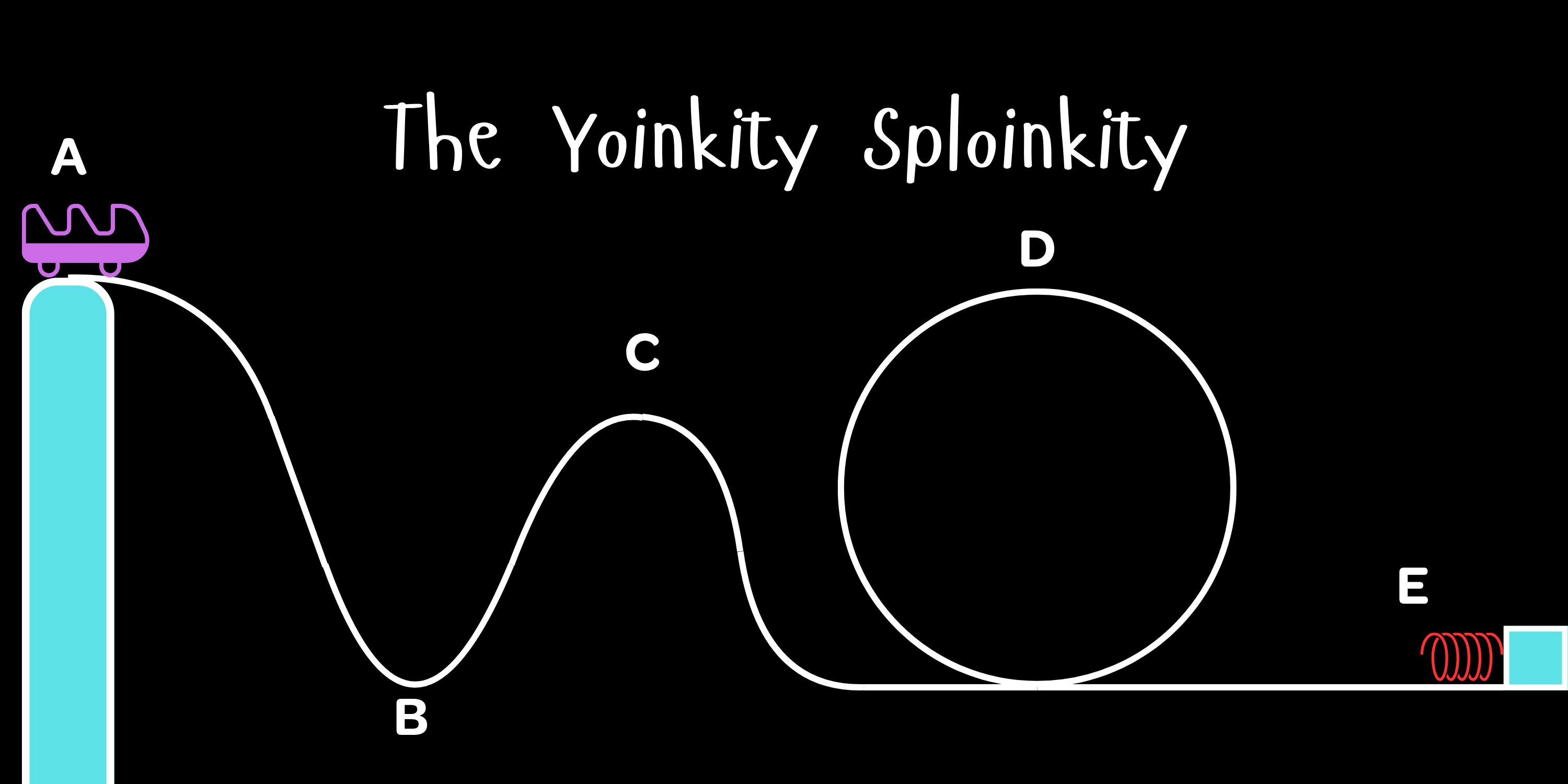
Consider the roller coaster shown below. The car (mass $m = 65 ~\textrm{kg}$) starts with zero velocity and is gently pushed off the starting platform, which is $H = 6.0 ~\textrm{m}$ above point B. Points B and E are at the same height, while point C is located $h = 3.5 ~\textrm{m}$ above them. The spring is located immediately after point E and has a spring constant $k = 1200 ~\textrm{N/m}$. All surafces are frictionless, and air resistance can be neglected. Consider the roller coaster shown below. I'm going to throw a lot of information at you, so be ready! The car starts with zero velocity and is gently pushed off the starting platform. Points B and E are at the same height. The spring is located immediately after point E and has a spring constant. There is no friction or air resistance.
Figure 3: Our newest roller coaster, The Yoinkity Sploinkity. This problem is going to have a lot of parts, so be ready.
Before we start, we should define the system we are dealing with. We can consider the car and the Earth to be the system even though only the car is really being analyzed. This is because the mass of the Earth is so large that none of its energies (potential or kinetic) change significantly as the car moves, meaning we can include it in our system without considering its energy. This is a common technique and is the only way to solve these problems, since we can't deal with gravitational potential energy if we don't include the Earth in our system.
Now we're ready to actually begin calculations. The first thing I will ask for is the velocity of the cart at point B, C, and E. Point D is kind of a special case that we'll get to next. Use the technique of the conservation of mechanical energy!
Ready? The car at point A has zero kinetic energy and some amount of potential energy. Since the lowest the car ever goes is to point B a height $H$ below the starting position, we can say points B and E have zero potential energy. This lets us solve for the velocity at point B $v_b$ now:
$$ U_i + K_i = U_f + K_f $$ $$ mgH = \dfrac12 m{v_b}^2 $$ $$ v_b = \sqrt{2gH} = \bbox[3px, border: 0.5px solid white]{10.8 ~\textrm{m/s}} $$ You might have noticed that the first line looks a bit new. It's really just a more practical way to write the conservation of mechanical energy, however: we have terms representing initial and final potential and kinetic energies.
Next, we can do the same approach for point C, which is $h$ above point B. We compare this with the initial state at point A again. We can do this because energy is conserved throughout the entire motion of the car!
$$ mgH = \dfrac12 m{v_c}^2 + mgh $$ $$ v_c = \sqrt{2g (H-h)} = \bbox[3px, border: 0.5px solid white]{7.00 ~\textrm{m/s}}$$ We could move on to do the same calculations for point E, but we can recognize something that will save us this work. See, points B and E are at the same height, and potential energy only depends on the height and not the path of an object. This means that the potential energy at point E is zero just like in point B, allowing us to conclude that the velocity at point E $v_e$ must be equal to $v_b$.
$$ v_e = v_b = \bbox[3px, border: 0.5px solid white]{10.8 ~\textrm{m/s}} $$ First part of the question down! Next, we're going to deal with the circular loop-de-loop at point D. Let's find the maximum possible radius of the loop $R$ such that the car doesn't fall out of the loop.
Since the car is going in a circle, it's not as simple as just using conservation of energy. We need to consider that the car is undergoing circular motion, which means that it must have some centripetal acceleration. The two forces that could supply this at the top of the loop are the normal force and gravitational force. The normal force can vary, but gravity is constant.
You want to recall from our centripetal force/acceleration lesson that at the critical velocity where the car is just barely able to stay in the loop, the normal force is zero. This means that the gravitational force must be the only force providing the centripetal acceleration. This means that we can write:
$$ mg = \dfrac{m{v_d}^2}{R} $$ This yields the result (which should look somewhat familiar!):
$$ R = \dfrac{ {v_d}^2}{g} $$ We should also write this in another form:
$$ v_d = \sqrt{gR} $$ Now, we need to find the velocity at point D $v_d$. We can use the previously shown method that we used for points B, C, and E, being conservation of mechanical energy. Point D is at the top of the loop, which is a height $2R$ above "ground level" (zero potential energy). Thus, we can write:
$$ mgH = \dfrac12 m{v_d}^2 + mg(2R) $$ We next want to substitute the expression we found for $R$ into this equation, which gives us:
$$ mgH = \dfrac12 m (gR) + 2mgR) $$ $$ H = \dfrac{5}{2} R $$ $$ R = \dfrac{2H}{5} = \bbox[3px, border: 0.5px solid white]{2.4 ~\textrm{m}} $$ We just found the maximum radius of the loop! If the radius is any larger, the car will not be able to stay in the loop. And we would get a lot of lawsuits if that happened.
That spring at point E looks like it could use some attention. This leads into the last part of our very lengthy problem. We want to find the maximum compression of the spring $x$ when the car hits it.
We can use conservation of mechanical energy again, but this time we need to consider that the spring has some potential energy as well. When it is fully compressed, the car will be momentarily stopped, which means that it has zero kinetic energy. As an added bonus, point E is at the point of zero potential energy, allowing us to drop yet another term! See how convenient being smart about your choice of the zero point can be? Thus, we can write:
After the spring compresses, it would push the car back up the track, converting the spring potential energy back into kinetic energy. However, in the real world this isn't exactly desirable. In any case, we're not really concerned with all of this practical application stuff, just the physics behind it.
Phew! That was a long problem, but we got through it. We used conservation of mechanical energy to find the velocities at points B, C, and E, the maximum radius of the loop at point D, and the maximum compression of the spring at point E. Even saying that now makes me want to take a nap. But what happens if we add friction to the problem?
Obviously, we can't solve this exactly for many reasons. First off, the track is curved, so the frictional force will vary because the normal force will vary. Second, we don't know the exact length of the track, which makes it impossible to calculate the energy dissipated by friction.
What we can know, however, is that the cart will slow down and possibly even stop due to energy dissipated by friction. Whereas the velocities at point B and E were both $10.8 ~\textrm{m/s}$, they will now be less than that, and the velocity at point E will be less (if the car even reaches point E) because more energy is dissipated by friction by the time the car reaches that point.
In all honestly, the car would probably not even reach the spring at point E because of the loop-de-loop. Recall that the car needs some minimum velocity at the top of the loop to stay in it, which we calculated to be $v_d = \sqrt{gR}$. If friction was in play, the car would likely not have this critical velocity at the top of the loop. This would be pretty bad for the roller coaster, as it would mean that the car would not be able to complete the loop and...
Well, let's just say gravity would do its thing.
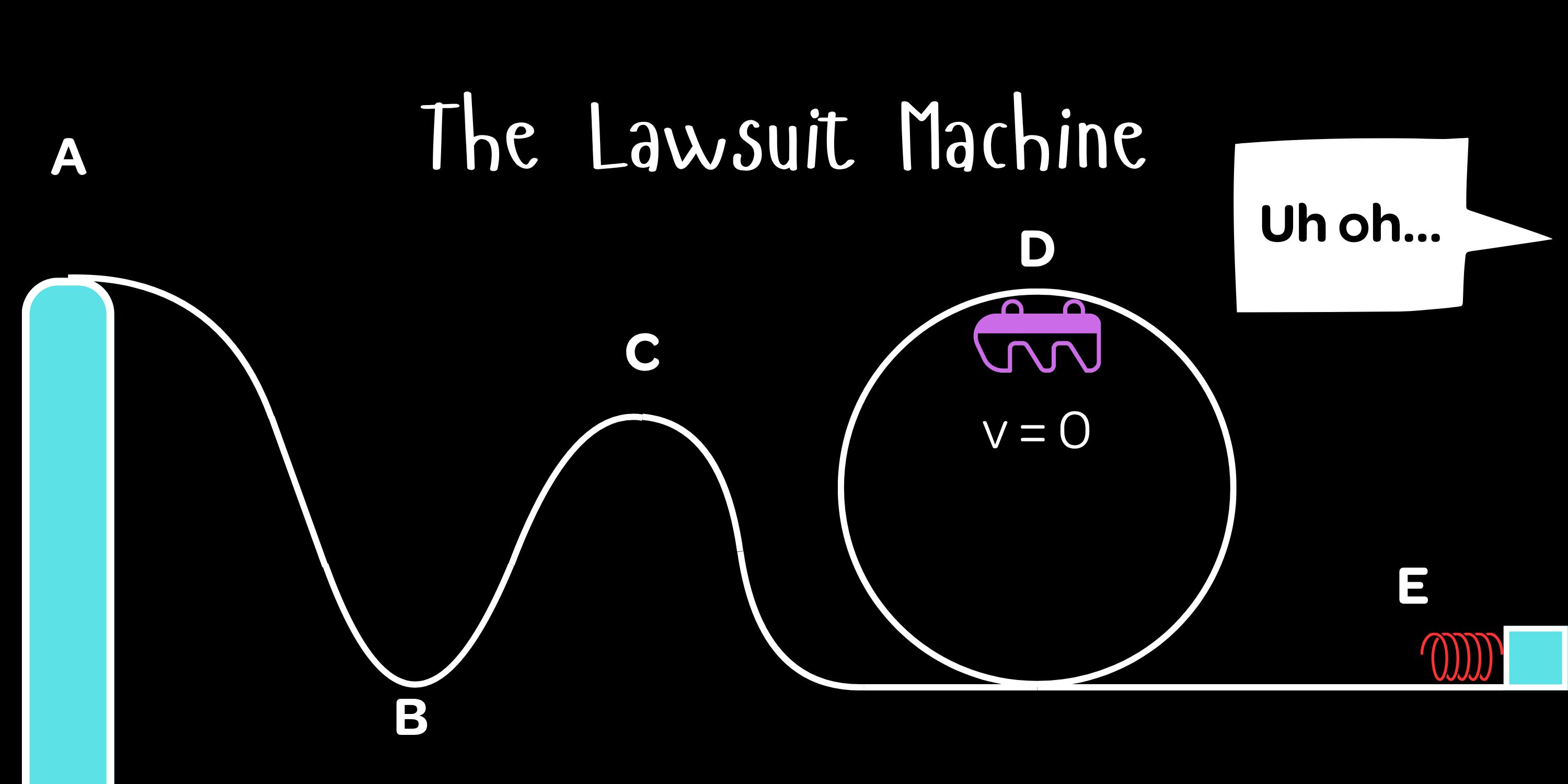
Figure 4: The disastrous results of failing to account for friction in a real ride. The coaster has been aptly renamed. We'll deal with this problem in a conceptual way. The car starts at point A with zero velocity and is gently pushed off the starting platform, which we interpret to mean that it gains no velocity or negligible velocity when starting out. Thus, the total mechanical energy at point A is just the potential energy, which is $mgH$.
But hold on! Gravitational potential energy is relative, so we need to define a point of zero potential energy. A convenient point is at the bottom of the ramp, which is labelled point B. This means that the potential energy at point B (and point E) is zero, which justifies our previous expression of the potential energy at point A as $mgH$.
At points B and E, the velocity should be the same, since they are at the same height. In fact, the velocity is the same at both points and equal to $v_b = v_e = \sqrt{2gH}$. This result is a consequence of the conservation of mechanical energy. If you want to see the full derivation, you can check out the algebra-based or calculus-based difficulties.
Point C also exists, but is rather simple to deal with. It is at a height $h$ above point B, which means that the potential energy at point C is $mgh$. This allows us to again write energy conservation. You might be thinking that we have to use the expression for total mechanical energy at point B, but in fact we can just use the total mechanical energy at point A again, since energy is conserved throughout the entire motion of the car.
Doing the calculations yields us a result of $v_c = \sqrt{2g(H-h)}$.
Now, the next point of interest is point D. This point is at the top of a loop-de-loop, which means that the car is undergoing circular motion. This means that the car must have some centripetal acceleration, which is provided by the gravitational force and the normal force. We are going to look for the maximum radius of the loop $R$ such that the car does not fall out of the loop.
Recall our circular motion lesson back in the last unit, where we dealt with a vertical circle. The same results we got there apply here. Since we are analyzing the critical condition where the car is just barely able to stay in the loop, we can assume that the normal force is zero. This means that the gravitational force must be the only force providing the centripetal acceleration.
This allows us to write: $$ mg = m\dfrac{ {v_d}^2}{R} $$ This yields the result (which should look somewhat familiar!):
$$ R = \dfrac{ {v_d}^2}{g} $$ $$ v_d = \sqrt{gR} $$ These two results are equivalent, just in different forms. Now, we know the potential energy at point D is $mg(2R)$, since it is at a height of $2R$ above the bottom of the ramp. This allows us to use conservation of mechanical energy to find the value of R, which we find to be $R = \dfrac{2H}{5}$.
Now, think about what happens to the car at point E, where a spring is located. The spring has a spring constant $k$, but we're not concerned with numbers in this part. This is a conceptual question for a conceptual difficulty. What happens to the car's energy at point E?
The car will have some kinetic energy as it reaches point E, which we've shown to be true before. However, at point E there is a spring that will compress when the car hits it, eventually stopping the car momentarily. At this point, the car has zero kinetic energy, but the spring has some potential energy. This means that all of the car's kinetic energy is converted into spring potential energy!
Since spring potential energy is completely recoverable, this means that theoretically the spring could push the car all the way back up the ramp to point A, converting the spring potential energy back into kinetic energy. I'm not sure how practical or fun this is, since you'd be travelling backwards along the track.
That was a long problem, huh? We're almost done, but I can still pose another conceptual question for you to think about. What happens if we add friction to the problem?
Well, the car will slow down and possibly even stop due to energy dissipated by friction. The further along the track it goes, the more energy is dissipated by friction. The car would probably not even reach the spring at point E because of the loop-de-loop. Recall that the car needs some minimum velocity at the top of the loop to stay in it, which we found. Friction would likely dissipate away enough energy that the car would not have this critical velocity at the top of the loop, causing the car (and passengers) to fall out of the loop and crash to the ground.
Figure 4: The disastrous results of failing to account for friction in a real ride. The coaster has been aptly renamed.
We are so close to being done with this lesson! The last thing we need to talk about is how to add or remove energy from a system by doing work on it. This allows us to deal with situations where mechanical energy isn't conserved, but we know the work done on the system.
Work-Energy Theorem (revised)
The work-energy theorem states that the work done on a system is equal to the change in mechanical energy of the system. (Previously, I introduced this as just the change in kinetic energy!) This means that if we know the work done on a system, we can find its change in mechanical energy.
You might recall our formula for the change in mechanical energy caused by friction, which stated that the net work done by friction is equal to the change in mechanical energy. Well, this formula takes a similar form, but is more general.
$$ W_{net, ext} = \Delta E_{mech} = E_{mech,f} - E_{mech,i} $$ We only consider the net external work done on a system to find the change in mechanical energy. This brings us back to the idea of internal versus external forces. While internal forces can still dissipate energy within a system, they must be nonconservative forces to do so. Conservative interaction between a system, such as when the Earth exerted a force of gravity on our roller coaster car, do not change the total mechanical energy of the system.
Regardless, if the net external force on a system does work, then the mechanical energy of the system will change. It doesn't matter if this net external force is conservative or nonconservative, as long as it does work on the system.
If you've been paying attention, you might have noticed that this is very similar to the formula we used earlier to calculate the change in kinetic energy. Indeed, this is just a more general form of the work-energy theorem, replacing kinetic energy with mechanical energy to allow it to be applied more generally.
Recall our old friend, the work-energy theorem. I introduced it by stating that the work done on a system is equal to the change in kinetic energy of the system. This is a very specific case of a more general formula that we can use to find the change in mechanical energy of a system.
$$ W_{net, ext} = \Delta E_{mech} = E_{mech,f} - E_{mech,i} $$ You might notice that this formula is just the work-energy theorem generalized to mechanical energy. Indeed, that is exactly what it is. The net external force will change the mechanical energy of a system by doing a net work on it. It doesn't matter if this net external force is conservative or nonconservative, as long as it does work on the system.
Dissipative forces can also change the energy of a system even if they are internal, but these are always nonconservative in nature. If a conservative force is an internal force, it will not act to change the total mechanical energy of the system.
Conclusion
That's all there is to energy and energy conservation! We can use this technique to solve many problems that we previously couldn't, saving ourselves a good amount of time and effort along the way as well. Next, we're going to sort of pivot to a topic that might seem unrelated, but is actually tied closely into the idea of potential energy. Equilibrium is a concept that has been discussed before, but we will expand significantly on it in the next lesson.
 The AntiMatter Lab